
Hypervigilance: The Survival Mechanism That Never Shuts Off
What it feels like when your nervous system never calms down—and the exhausting cost of living this way
You know how a dog that’s been hit all the time will pull back when you reach out to pet it?
They think you’re going to smack them again.
Their nervous system is shot, and they anticipate being hit.
They’re hypervigilant, always worried they’re going to be punished.
Guess what? Human beings do the same shit.
That animal’s nervous system becomes wired for threat detection. Every hand reaching toward them could be danger. Every sudden movement triggers retreat. They’re not being difficult—they’re surviving the only way they know how. I know this because I lived it. Still living it, actually.
Hypervigilance doesn’t just turn off once the threat is gone. It may get wired into your nervous system. It can become part of how you move through the world. And if you learned it young, you may not remember a time before it.
This is hypervigilance. And if you’ve been living with it, you already know—it’s exhausting in ways most people will never understand.
It falls into ‘things you don’t know, that you don’t know.’
How Did It Start?
A visual metaphor for functional depression and hypervigilance.
I don’t have a specific moment when hypervigilance began. There isn’t a specific event—it was more organic.
You get in trouble once. You get in trouble twice. You keep getting in trouble, and you begin to prepare for the next time because chances are it’s going to happen again. For context, the 1970s version of “getting in trouble” involved a spanking for me. It was standard issue for a disciplined house back then. I submit that most of Gen-X would agree with me on that specific, even if they didn’t get spanked.
So you start trying to anticipate it.
If I do this, will I get in trouble? If I do that, will I get in trouble?
It becomes this cyclical dialogue with yourself. One passes judgment on everything involved before making a move.
Fear sits in the driver’s seat, pitching narratives, getting you to make decisions you probably shouldn’t be making. And if that fear is coming from your subconscious—in most cases it usually is—you’re not even aware of what’s happening.
What you know is you don’t like how you feel and want it gone.
How it gets amplified.
Think of it like a snowball at the top of a snowy mountain. You chuck it down the hill, and by the time it gets to the bottom, it’s bigger than a house. That’s hypervigilance build up. It gains momentum. Its mass becomes larger, and it needs constant fuel— provoking, real threats or imagined threats, anxiety.
Imagine an car engine revving up, pushing the tachometer needle into the red—that’s marked the danger zone for a reason.
It’s okay to hit the red once-in-a-blue-moon. But to be up there all the time? That can’t be good.
Keep in the red and engines blow. With humans, it can be different. Some will burnout. However, some continue to build “mental muscle” and make it second-nature.
Its like ‘hard-coding’ it into your operating system at root level.
My hypervigilance and masking were learned in the same household, simultaneously. Same childhood environment, same survival strategy.
Both were necessary.
Both became part of the life-long survival toolkit.
What It Feels Like
When I was young—kindergarten, first grade—I’d be stuck inside during winter because it wasn’t fun to go out when it was five degrees.
So one was in the house with parents a LOT. And at a very early age, I learned to pay attention to everything but myself for what my subconscious deemed ‘safety protocol.”
The song that comes to mind for me is XTC’s “Senses Working Overtime.” The chorus sings emphatically:
“One, two, three, four, five senses working overtime, Trying to take this all in, one, two, three, four, five senses working overtime…”
That’s exactly what hypervigilance is.
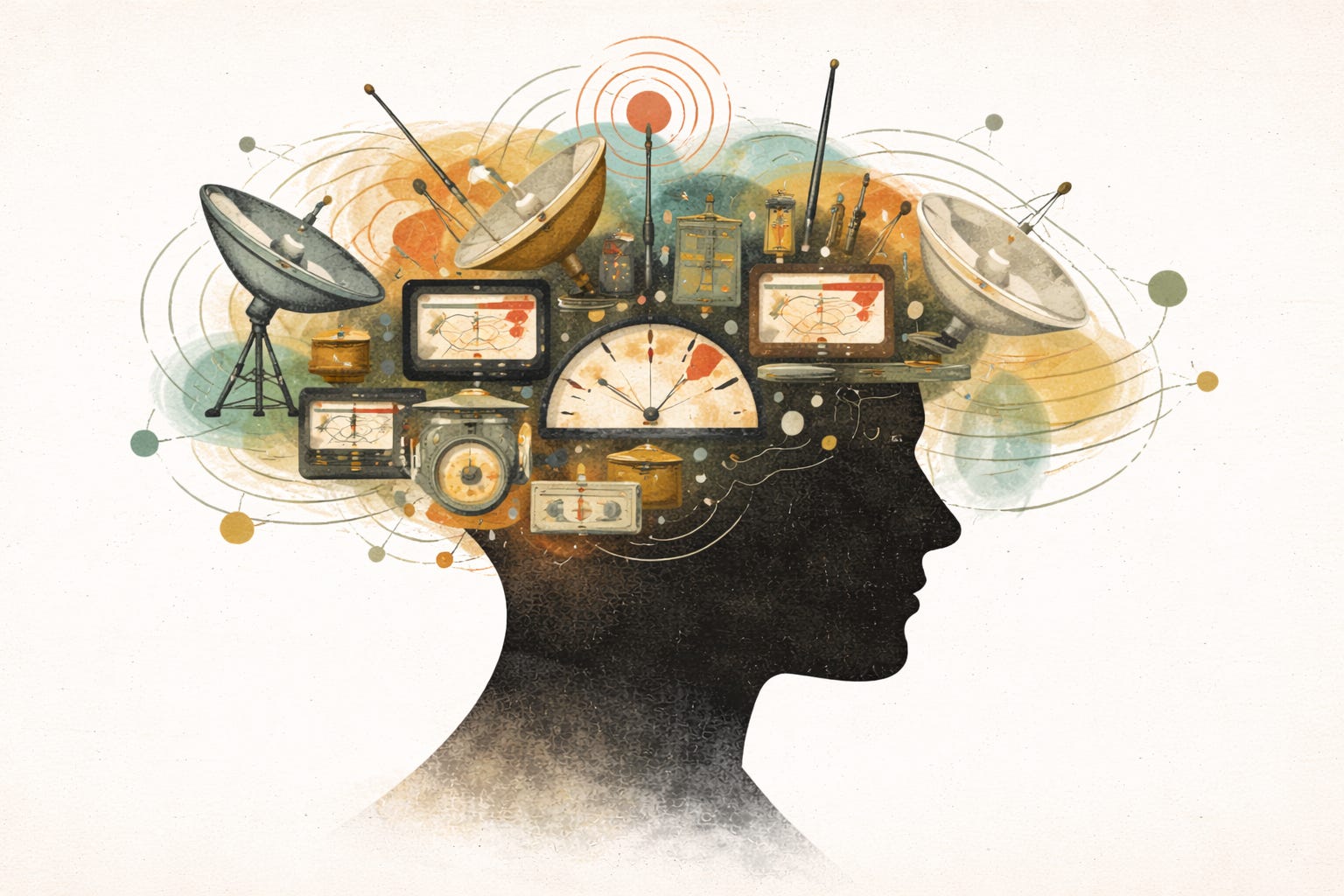
All your senses on overdrive, all the time.
Hearing becomes acute. You hear every cough, every murmured word, every chair being pulled across the floor, anything being dropped or thrown, doors open and shut. I’d wake up in the middle of the night to the sound of smashing plates or cups— a piece of the soundtrack of my childhood.
Seeing is constant scanning. Eyes always moving, looking for threats, looking for safety. When I walk into a room even now, I scan it without thinking. I’m looking for a safe space, and I’ll drift toward it immediately. Where are the least amount of people to minimize interaction? That is also an objective fueled by deep shame and lack of self-esteem.
Touch isn’t just physical. It’s the hairs standing up on your arms, on the back of your neck. You feel a shift in energy in the room. You’re attuned to the environment in a way that’s hard to explain if you haven’t experienced it.
Its all the pores on your body opening at once. Shooting out cold sweat, and you can feel each one.
If there is a breeze from a passing fly, you would feel it.
I did not discover until later in life that I was born a very sensitive, empathic kid with all my sensors turned on and wide open to take the whole human experience all in.
But somewhere along the way, I think my body or subconscious turned the sensitivity down—not off, but down—because it was too much.
I was born with sensitive equipment, and it was constantly bombarded by overwhelm. At first that would make me shut-down. However, to show that “I was ok” I learned to mask shut-down.
I stuffed it down and pretended to be ok.
And somewhere amidst the overwhelm if feels as though the equipment was either shut off, or sensitivity was turned WAY down.
I can barely pick up on energy shifts now the way I used to. But I’m getting better at it the more I can calm my nervous system.
And the startle response? Off the charts. If somebody dropped a ball on the floor, I’d jump. The worst was my father’s sneeze. It’s so loud, so quick, high-pitched—no buildup, just BANG. It made me jump more than anything else when I was young. From high school and younger, that sneeze was a guaranteed jolt to my nervous system.
How It Showed Up in Childhood
In grade school, I used hypervigilance to stay safe. To avoid being punished—physically, emotionally, psychologically. But I also used it in the classroom.
I’d pay attention to how teachers talked to me and how they talked to other kids. I was comparing myself to others at a very early age—not healthy. The hypervigilance wasn’t just about survival at home—it was about observation, data collection, threat assessment everywhere.
I used it for two things in the classroom: one, get the teacher to like me so they wouldn’t abandon me. Two, do the same thing with other kids.
I wanted to be friends with other kids. I didn’t want to be the outcast, the kid that gets picked last in gym class.
Sadly, I was that kid anyway. Maybe I was a “try-hard?”
When junior high and high school arrived, the “I want to be friends” thing turned inward. The hypervigilance shifted to harsh comparison, ridiculous standards, self-judgment, and self-criticism.
I was still scanning for threats and looking for allies, but now I was also comparing myself to everyone and everything around me. Watching for bullies to avoid, watching for potential friends to approach, constantly calculating who was safe and who wasn’t. It never stopped.
And now? I can turn it on/off at will.
How It Manifests in Adulthood
Hypervigilance in adult life shows up as people-pleasing behavior based in subconscious fear of abandonment. You put others needs before your own, and are deferential to others desires.
It’s about getting people to like you, making sure they don’t think you’re a jerk.
Trying too hard to show people you’re a good person instead of just being a good person.
The hypervigilance makes you preoccupied with communicating something to someone without just outright saying it. And it’s all self-generated worry and anxiety, all inside your head.
How can I support you?
What can I do?
Are you okay?
Do you need anything?
Is there anything more I can do to bother you? (sarcasm)
That worry may become obsessive to the point of compulsion.
And I’ve done that to people. It cost me.
It created the opposite reaction of what I actually wanted—I want closeness, but it created distance because frankly, I’m being a pain in the ass.
Who wants to get close to a pain in the ass?
I don’t, and likely you as well.
I was hypervigilant in my marriage because I was worried about being abandoned. I obsessively asked my spouse if she was okay, constantly scanning for signs that something was wrong, or just “off.”
Ultimately, I got the outcome I worried most about. Hypervigilance contributed to the downfall of my marriage. At the time I didn’t know that it was. I knew it was bothersome at times. However, in retrospect I can see how it could be percieved by someone on the other side of the equation.
That’s the beautiful pain of hindsight, and it frankly sucks.
But here’s the thing about hypervigilance in adulthood: for some it’s also a forecasting tool.
Like a chess player, Hypervigilance looks three, four, five, six steps ahead of where its at.
I’m trying to anticipate what needs doing, what I need to provide, what the other person might do or say, what an entire group of people might do or say, or what might be a threat?
A never ending hypothetical assessment production line in their head. Create hypotheicals, predicting outcomes, preparing for chaos, preparing for ambiguity, preparing how to move, preparing for everything you can think of if given enough time.
And when crazy shit actually shows up?
Since some things have already been considered, hypervigilance can be seen as a benefit—especially in groups, with strangers, or in crisis situations.
It’s far less effective one-on-one, where the intimacy and closeness, or emotions override sensibility.
So it’s both.
It’s a survival tool, that can be a superpower, that’s also exhausting.
It helps me stay prepared
and destroys my ability to relax.
That’s the duality.
The Cost
I’m unsure if I’ve felt my nervous system entirely calm in my body. Not that I can consciously or intentionally remember. I wake up light a light switch, one second I’m asleep, 2 seconds later I’m on my feet. There are no sleepy eyed slow mornings when dysregulated.
My nervous system was very weirdly sensitive, born that way it seems. So if my brain sensed threat, it went to hypervigilance and that means becoming dysregulated.
When I was young hypervigilance felt wired in. I was ADHD as a kid, made it hard to keep focus on one thing, when all the sensors are bringing in data non-stop. I somehow maintained B+ average through school. I guess I “figured it out” from a survival perspective. It may have been get good grades, or else…
I meditate a lot
Over 30,000 minutes across 1,300+ days.
Working to calm my nervous system and be still.
I’m getting better at it, and I’m working on it.
There’s infinite room for improvement and more stillness.
I look forward to a full, deep calm experience every meditation.
Hypervigilance drains my energy constantly, which compounds the intensity my depression.
Always scanning means never truly resting.
The performance required to mask while also staying hypervigilant?
That’s a recipe for complete exhaustion. It’s hard to relax when your body has been trained to stay on high alert. Even when there’s no conscious threat, your nervous system doesn’t believe it. As if your inner meerkat will ever lie down and not look for threats?
You’re still revving in the red subconsciously,
waiting for the next thing to go wrong.
What I Want You to Know
Hypervigilance can be a survival skill, and a positive tool if wielded intelligently. If you learned it as a kid to get by, you needed it. It kept you safe when safety wasn’t guaranteed. It helped you navigate environments where you had to predict outcomes just to get through the day.
But it’s can also be a burden. It doesn’t turn off when the danger passes. It stays with you, embedded in your nervous system, shaping how you move through the world.
Some of us are still working to calm it down
Some of us are realizing we’ve been living this way our entire lives
And some have learned to use it as a tool while also knowing the cost
It can also be a super power.
Hypervigilance is great at planning and predicting outcomes for projects. And in real world scenarios it provides split second thinking and pattern recognition to see things before they happen. It can save your ass.
For example, in software design hypervigilance helps anticipate unseen obstacles, and unknown consequences through the use of hypotheticals. If you remember earlier, “what about this? what about that?” assessment thinking can sort out things subconsciously.
Hypervigilance is a survival tool and skill that has to power to keep you out of harm’s way and plan intelligently. The key, awareness in it not taking control of narrative—aka, “not driving the bus.”
We’re all different. The outcome isn’t guaranteed.
What I do know is this: if you’re living with hypervigilance, you’re carrying a weight most people can’t see.
You’re constantly scanning, predicting, preparing. And that takes a energetic and mental toll not matter who you are—its human.
I see you. I know what it costs. And I’m working on harnessing it too.
I’m learning—every day—to ease up on myself.
Show myself grace and compassion.
It still feels foreign, but I keep up the practice.
A contribution to getting better.
Be well.